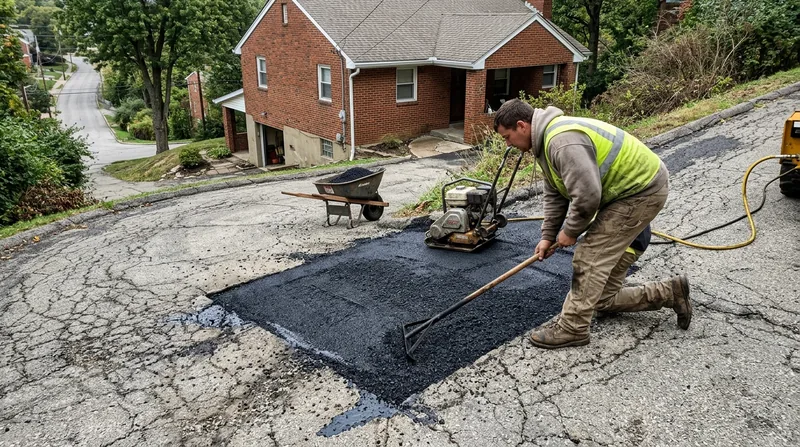




Cincinnati driveways crack most often along the downhill edge where hillside ground has shifted under the freeze-thaw cycle. If you live on a slope in Mount Adams, Price Hill, East Walnut Hills, or Mount Auburn, you know the pattern: a line of failure appears where the asphalt is pulling away from the grade, and water gets underneath. Out on the flatter ridges in Mason, West Chester, or Anderson Township, the damage tends to spread across the surface as alligator cracking when the base begins to fail. Either way, driveway repair in Cincinnati is not a cosmetic fix. We cut back the failed asphalt, rebuild the base so it holds through Ohio's wet springs and freeze-thaw winters, and patch it so the repair stays put. The work is concrete, the results are measurable, and the cost is a fraction of replacement.
Why Driveway Repair Matters in Cincinnati's Variable Terrain
Cincinnati's geography splits the driveway repair problem into distinct zones. In the basin, rowhouses and Italianate homes on narrow, shared drives in Clifton and Price Hill deal with age and the wear of tight access. Climb the hillsides and the issue becomes ground movement. Saturated colluvium (the weathered shale and glacial soil on Cincinnati's slopes) shifts when it is wet, which it is every Ohio winter and spring. That movement cracks asphalt faster than freeze-thaw alone. Out on the ridges and in the suburban townships, standard post-war driveways fail from ordinary frost heave and base breakdown, but the ground underneath is more stable. Understanding which failure mode is happening under your driveway tells you what repair will actually hold.
- Downhill edge cracking signals ground shift and requires base reconstruction, not just patching the asphalt.
- Alligator cracking across the surface means the base has failed and a patch will not last more than one or two seasons.
- Pothole formation in spring indicates frost heave and water trapped in the base, which must be cleared before the hole is filled.
- Linear cracks running parallel to the drive edge often follow utilities or old cuts and can be sealed or patched depending on depth and width.
Getting the diagnosis right is the difference between a repair that lasts five years and one that fails in six months. We measure the crack pattern, probe the base, and tell you whether a patch is worth the money or whether the driveway needs resurfacing.
Key info: In Cincinnati, permits for driveway work are set by your municipality. The City of Cincinnati, Norwood, Blue Ash, and other villages each have their own rules for aprons, curb cuts, and impervious surface. We help you navigate those requirements, and if you have an HOA, architectural approval is your responsibility to verify. Always check with your local building department before work begins.
For more on what causes driveways to fail and when to repair versus replace, see our page on asphalt resurfacing and overlay.
How We Repair Driveways in Cincinnati: Step by Step
A lasting driveway repair starts with understanding what failed and why. We do not just fill a hole and move on. We cut back the failed asphalt to solid ground, assess the base underneath, remove standing water or soft material, and rebuild the base if it is compromised. Then we patch with hot mix asphalt compacted to the same density as the surrounding drive. The repair is finished level and smooth, and it is built to handle another five to ten years of Cincinnati's weather.
- We inspect the crack or pothole, measure its extent, and probe the base to see if it is solid or soft.
- We cut back the failed asphalt in a clean line, removing all loose or cracked material back to sound pavement.
- We clean the cut, remove debris and standing water, and inspect the base for damage or washout.
- If the base is soft or broken, we remove it, grade the subgrade, and add new compacted stone base.
- We fill the repair with hot mix asphalt, compact it firmly, and finish it flush with the surrounding surface.
The whole process takes a few hours for a small to medium repair. Larger or deep repairs may take longer, and we will give you a realistic timeline on the estimate.
Example: A homeowner in Mount Auburn noticed a two-foot downhill edge crack pulling away from the grade. We cut back the failed asphalt, found soft base underneath, removed it, re-graded and compacted new stone, and patched it with hot mix. The repair cost less than half of a full resurface and held through the next two winters because we addressed the ground movement, not just the asphalt.
To learn more about when a patch makes sense and when you need resurfacing instead, visit our pricing page for a full breakdown of repair, resurfacing, and replacement costs.
| Repair Method | Description | Best For |
|---|---|---|
| Pothole Patch | Cut back failed asphalt, repair soft base, fill with compacted hot mix asphalt. | Single potholes or small localized failures in an otherwise sound drive. |
| Full-Depth Patch | Remove all asphalt and failed base, rebuild subgrade and stone base, install new asphalt. | Larger failures, ground movement, or washouts where the base is compromised. |
| Edge Repair | Cut back downhill edge cracking, rebuild base if ground has shifted, patch with hot mix. | Hillside driveways in Cincinnati where saturated ground has moved the edge. |
| Crack Seal or Fill | Clean and fill linear cracks with flexible material to prevent water infiltration. | Hairline and shallow cracks that have not yet become potholes or widespread failures. |
Driveway Repair Cost in Cincinnati: What to Expect
A typical pothole or small localized patch in Cincinnati runs from $450 to $800, depending on how deep the failure is and whether the base underneath is solid or needs rebuilding. A larger repair that spans several feet or requires significant base work can run $800 to $2,000 or more. The cost moves up if the ground has shifted (common on hillsides), if water damage has softened a wide area, or if access is tight and equipment cannot get close to the work. We measure the job on site, look at the base, and give you a written estimate with tonnage and thickness specs so you know exactly what you are getting.
The smartest move is to get the repair done before a small crack becomes a pothole that eats into the base. A $500 patch now costs far less than a $3,000 full-depth repair later. If your driveway has extensive alligator cracking over more than thirty or forty percent of the surface, patching throws money away. In that case, resurfacing or overlay is the better investment.
We do not charge for the estimate, and we respond within 24 hours. Call us at (513) 813-2379 or request a free estimate online.
Driveway Repair Near Me: What to Look for When Hiring a Paving Contractor in Cincinnati
The driveway paving trade has a long history of door-to-door crews with out-of-state plates offering "leftover asphalt from a job nearby" at a price that sounds too good. Avoid that pitch entirely. A good contractor is local, has a local address and local phone number, and can show you previous work in your neighborhood. Get the estimate in writing with the thickness of the asphalt, the tonnage, and the base specifications spelled out. Do not sign anything that promises a lifetime warranty on the asphalt itself, because asphalt is a material, not a manufactured product, and carries no maker guarantee. A workmanship warranty of one to three years on the installation is standard and honest.
Before you hire anyone, verify that your municipality does not require a permit. In Cincinnati, some driveway work requires a permit and some does not. Your local building department can tell you. If you have an HOA, check the architectural rules for material and color restrictions. If your driveway extension or repair involves a curb cut or apron, permits are almost certainly required. Always call Ohio 811 before any excavation to have utilities located. It is the law, and it protects you and the contractor.
Ask for references from recent jobs, check that the contractor carries liability insurance, and get two or three estimates so you understand the range. A contractor who is verifiably local, who puts the estimate in writing, and who asks the right questions about your site and your needs is worth hiring. Contact us for a free estimate, and we will walk you through the process and answer your questions.
Driveway Repair in Cincinnati: Pricing Guide
| Service | Price | Details |
|---|---|---|
| Pothole or small patch repair | Starting at $450 | One to three potholes or localized failures, solid base underneath, standard access |
| Medium patch or edge repair | Starting at $800 | Larger failure area, soft or compromised base requiring removal and rebuilding, hillside edge repair |
| Multiple patches or extensive repair | Starting at $1,500 | Several separate failures, widespread base damage, or difficult access requiring staged equipment setup |
| Full-depth replacement of failed section | On estimate | Large area, severe ground movement, extensive washout, or structural failure requiring full base rebuild |
| Travel and site visit | Included | No separate charge for travel within Cincinnati and surrounding areas, all included in estimate |
| Free estimate | Free | Written estimate with tonnage and thickness specs, 24-hour response, no obligation to book |
Indicative pricing, the exact cost depends on square footage, finish, and site access. Free personalized estimate within 24h at (513) 813-2379.


