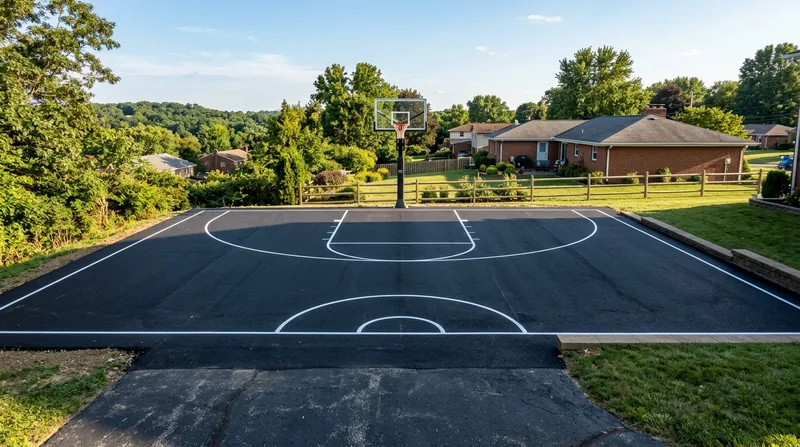




A backyard basketball court or tennis pad on a Cincinnati ridge lot starts with a problem: the ground is rarely level. Hillside properties in neighborhoods like Mount Auburn, Hyde Park and the eastern suburbs sit on glacial soil over shale bedrock that shifts with seasonal saturation. A Sports Court & Path Paving installation means grading that slope for proper drainage, building a stable compacted base, and finishing with smooth asphalt that plays true and sheds water. We handle the whole sequence, from site prep through final surface, so your court functions year-round without pooling or cracking.
Why Sports Court & Path Paving Matters in Cincinnati's Ridge and Hillside Properties
Cincinnati's topography splits its paving needs sharply. Out on the ridges and in suburbs like Mason, West Chester, and Montgomery, post-war lots are flat enough for standard driveways. But climb into the hilltowns, and the terrain changes. Price Hill, Mount Auburn, Oakley, and Walnut Hills sit on slopes where a backyard court is not just a luxury but a grading challenge. The ground moves in spring when saturated colluvium shifts under the shale, and freeze-thaw cycles in Ohio winters work through any base that is not properly compacted and pitched for drainage. A court that looks level when built will crack and settle if the base is not right.
- We grade the site to shed water away from the court and surrounding structures.
- We compact the base in lifts to achieve uniform bearing capacity across the entire pad.
- We finish with asphalt that is smooth enough to play true and thick enough to handle seasonal movement.
- We ensure proper edge detail so the court integrates with your yard and does not settle or crack at the margins.
A well-built court lasts 15 to 20 years with routine maintenance. A poorly prepped base fails in three to five years, and you end up replacing it.
Local example: A Mount Auburn homeowner built a basketball court on a slope that faced north and held water. Within two years, frost heave had buckled the court and opened cracks along the downhill edge. The base had been skimped. We removed the failed court, regraded the site with a 2 percent slope, compacted a six-inch base, and paved a new court that has held solid for eight years. The difference was prep, not the asphalt itself.
For permit requirements in Cincinnati and surrounding municipalities, check with your local building department. Some villages require a permit for court construction, others do not. If you live in an HOA community, verify architectural standards before you start. See the contact page to discuss permitting with us before you commit.
How We Build a Sports Court in Cincinnati: Step by Step
A court is not a driveway. Driveways tolerate some settlement because a car can handle a bump. A basketball court or tennis pad must be smooth and level, or play suffers and the surface cracks under stress. Our process starts with a site visit to understand the slope, drainage patterns, and soil conditions, then we build to a written spec that includes base thickness, compaction density, and asphalt mix design.
- We mark the court boundaries and establish grade stakes to show the finished elevation and pitch.
- We remove topsoil and any unsuitable material down to stable subgrade.
- We proof-roll the subgrade to identify soft spots, and we excavate and replace any weak soil with compacted fill.
- We place and compact a four- to six-inch base of crushed stone or recycled asphalt, in lifts, to the density required by the design.
- We set up forms and batter boards to hold the edge straight and level.
- We pave the court surface, typically 2.5 to 3 inches of hot mix asphalt, finished smooth and pitched slightly for drainage.
- We remove forms after the asphalt has cooled and cured enough to handle traffic.
The whole job usually takes three to five working days, depending on site size and weather. You cannot drive or play on the court for at least 24 to 48 hours after paving, and it continues to cure for six to twelve months, so do not seal it during that window.
Cincinnati example: A Madeira property with a steep north-facing slope wanted a tennis court. We cut a 4,200-square-foot pad into the hillside, moved about 40 cubic yards of earth, compacted an engineered base, and paved a smooth, well-drained court. The job took four days. The homeowner waited two weeks before playing, then used it trouble-free for six years. The key was respecting the slope and building the base right.
If you are also looking at driveway work or other paving on your property, see our asphalt driveway paving page for details on how we handle residential installations across Cincinnati and the suburbs.
Sports Court & Path Paving Methods and Materials
| Approach | Description | Best for |
|---|---|---|
| Full-depth court construction | Excavate to stable subgrade, compact engineered base, finish with 2.5 to 3 inches of hot mix asphalt. | New courts on sloped or problematic sites where base integrity is critical. |
| Overlay on existing base | If an old court or pad has a sound base but a failed surface, mill the top and pave a new wearing course. | Existing courts where the base has not shifted and the surface is the only problem. |
| Gravel or recycled asphalt pad | Grade and compact recycled asphalt millings or crushed stone for a less formal surface. | Budget-conscious paths, informal practice areas, or temporary courts in rural settings. |
| Pathways and connecting pads | Pave walkways to the court, parking pad, or gate using the same asphalt or recycled material. | Keeping the court accessible and integrated with the rest of your yard or property. |
Sports Court & Path Paving Cost in Cincinnati: What to Expect
A backyard sports court in Cincinnati typically starts at $8,500 for a small, well-sited pad on relatively flat ground with minimal grading. Most full-depth court builds run between $10,000 and $18,000, depending on size, slope, soil conditions, and how much earth has to move. A tennis court (2,600 square feet) on a steep hillside in Price Hill or Mount Auburn will cost more than a basketball pad (3,000 square feet) on a gentle slope in Mason or Sharonville because the grading work is heavier and the base design is more complex.
Factors that move the cost up include:
- Slope and elevation change: steeper sites need more excavation and fill.
- Soil type: clay and colluvium on hillsides are harder to work than stable ridge soil.
- Drainage challenges: saturated sites need more base material and careful pitch design.
- Access: narrow driveways or constrained yards slow the work and may require hand labor or smaller equipment.
- Surface size: a 4,000-square-foot court costs more than a 2,500-square-foot pad.
The only way to know the cost for your site is to get a written estimate. We measure the court area, assess the grade and soil, and give you a tonnage spec and a firm price. See our pricing page for more detail, and call us at (513) 813-2379 for a free, no-obligation site visit.
Sports Court & Path Paving Near Me: What Cincinnati Homeowners Should Know When Hiring
A sports court is a long-term investment, and the contractor you choose matters as much as the asphalt itself. Cincinnati sits in a region where paving scams are not uncommon. Itinerant crews show up with unsolicited offers, promise a low price, collect a large cash deposit, and disappear. Honest contractors work from a local address, put everything in writing, and give you a clear spec that includes base thickness and tonnage.
When you call a paving company in Cincinnati or a surrounding suburb, ask these questions:
- Can you provide a written estimate that includes the court size, base thickness, asphalt thickness, and tonnage?
- Do you carry liability insurance, and can you provide a certificate?
- Can you give me two or three references from recent court or paving jobs in Cincinnati or nearby?
- What is your process for drainage and base prep, and will you proof-roll the subgrade?
- Will you help me understand any permits required by the City of Cincinnati or my village, or verify HOA rules if I live in a master-planned community?
- How long after paving can I play on the court, and do you recommend any post-installation care?
A contractor who answers these questions clearly and without hesitation is one you can trust. One who quotes a price over the phone, asks for cash, or claims to have leftover asphalt from a nearby job is a red flag. Call us at our contact page or (513) 813-2379 to discuss your court and get a firm estimate.
Sports Court & Path Paving in Cincinnati: Pricing Guide
| Service | Price | Details |
|---|---|---|
| Small basketball court or path pad | Starting at $8,500 | 2,500 to 3,000 square feet on level or gently sloped ground with minimal excavation required |
| Tennis court or larger pad on moderate slope | Starting at $12,000 | 3,500 to 4,200 square feet with moderate grading, compacted base, and drainage design included |
| Court on steep hillside or complex site | Starting at $15,000 | Significant excavation, soil replacement, and engineered base due to slope, saturated soil, or difficult access |
| Connected pathways and aprons | Starting at $3,500 | Additional paving to integrate court with driveway, parking, or gate; scope and price depend on area and surface type |
| Estimate and site visit | Free | Response within 24 hours at (513) 813-2379, includes written spec with measurements and tonnage |
Indicative pricing, the exact cost depends on square footage, finish, and site access. Free personalized estimate within 24h at (513) 813-2379.


