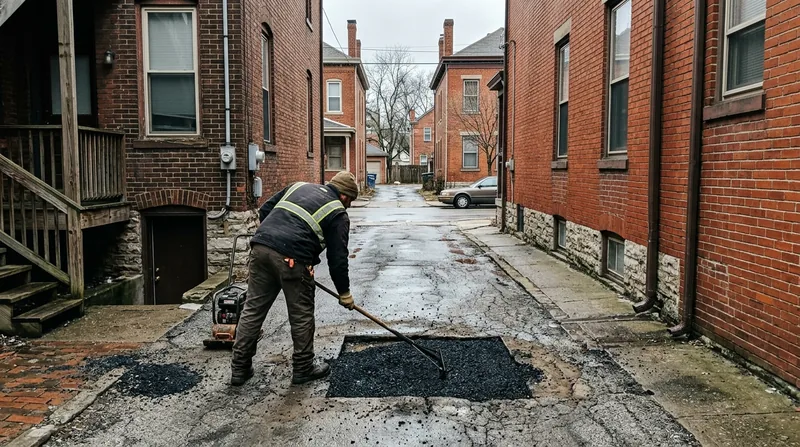




Pothole Repair & Asphalt Patching in Cincinnati is a direct response to the freeze-thaw cycles that dominate a Greater Cincinnati winter. When temperatures swing above and below freezing repeatedly through December, January and February, water trapped under the asphalt surface expands and contracts, breaking the bond between the wearing course and the base. By spring, that movement opens cracks, and traffic punches them into potholes. In the dense residential neighborhoods of the basin, Mount Adams, Clifton and Price Hill, where shared driveways and narrow lots are the norm, a single pothole can block access or force an expensive detour. We cut a clean square around the damage, tack the edges, and compact hot mix asphalt so the patch stays flush through spring rains and holds through the next winter cycle. The work is urgent because potholes grow fast, and a $500 patch today is a $5,000 full-depth replacement next year.
Why Pothole Repair Matters in Cincinnati's Winter Climate
Cincinnati sits in the transition zone between the Appalachian foothills and the glacial plains, which means the ground shifts. Freeze-thaw action is relentless from November through March, and the older the driveway, the faster the damage spreads. Basin neighborhoods like Mount Washington and Northside have driveways laid in the 1920s and 1930s on shallow bases that were never designed for the weight and frequency of modern traffic. Hillside drives in Mount Auburn and East Walnut Hills face a different pressure: saturated colluvium (the weathered shale and glacial soil that sits under the ridge) moves when wet, and Ohio springs are wet. Suburban driveways on the flatter ridges and in Anderson Township or West Chester often have better base preparation, but freeze-thaw still works through the asphalt itself. A pothole is not a cosmetic problem. It traps water, accelerates edge cracking, and forces the rest of the driveway to bear uneven load.
- Freeze-thaw cycles expand water trapped under asphalt, breaking the seal between layers and opening cracks into the base.
- Traffic impact widens those cracks into potholes within weeks, especially on older basin driveways with shallow bases.
- Water pooling in a pothole accelerates deterioration of the surrounding asphalt and base material.
- Early patching stops the spread and buys years before full resurfacing or replacement becomes necessary.
- Waiting for spring thaw to patch is standard, but cold-weather patching is possible in a pinch if temperatures stay above 40 degrees for the cure.
The cost of a single pothole repair is minor compared to the cost of ignoring it.
Key info: Cincinnati's basin neighborhoods (Mount Adams, Northside, Clifton) see pothole damage accelerate in late February and March as freeze-thaw cycles peak. Hillside drives in Mount Auburn and East Walnut Hills often show washouts and edge cracking where saturated ground has shifted under the asphalt. Suburban driveways in Blue Ash, Montgomery and Mason typically develop potholes from ordinary freeze-thaw action working through a sound base. Know your neighborhood's failure mode, and patch before the next winter cycle.
How We Repair Potholes and Asphalt Patches in Cincinnati
Pothole repair is a straightforward process, but the details matter. We first inspect the full extent of the damage: is it a single isolated hole, or is it part of a pattern of alligator cracking that signals base failure? If the pothole is isolated and the surrounding asphalt is sound, we proceed with a patch. If more than 30 to 40 percent of the driveway surface shows cracking or failure, patching throws money away, and resurfacing or overlay is the honest recommendation. Once we confirm the repair is the right move, we cut a clean, square perimeter around the damage, removing all loose or failed material down to solid base. We then tack the edges with a thin adhesive layer, set the hot mix asphalt, and compact it so the patch sits flush with the surrounding surface and bonds tight.
- We inspect the pothole and surrounding asphalt to confirm repair is the right choice, not a short-term patch over base failure.
- We cut a clean square perimeter around the damage, removing all loose material and exposing solid base or subgrade.
- We tack the cut edges with a bonding agent so the new asphalt adheres to the existing surface.
- We place hot mix asphalt into the square and compact it in lifts until it sits flush with the surrounding driveway.
- We allow the patch to cure before traffic resumes, typically 24 to 48 hours depending on temperature and weather.
The key to a patch that holds is clean edges, proper tacking, and full compaction so there are no voids or soft spots under the surface.
Example: A homeowner in Cheviot with a 1960s blacktop driveway notices a pothole in the middle of the drive after a hard freeze in early March. The rest of the driveway is sound, no cracking around the hole. We cut a 2-foot square, remove the failed base material, tack the edges, and place a 3-inch lift of hot mix. The patch cures in two days and holds through the spring. Total cost: $550. The same homeowner ignores it for six weeks, the hole grows to 4 feet across, and now the base under half the driveway is compromised. The repair cost is now $3,200 for a full-depth patch or $6,500 for a new driveway.
Pothole Repair Methods and When to Use Each
| Approach | Description | Best For |
|---|---|---|
| Shallow Pothole Patch | Cut and remove failed asphalt and loose base, tack edges, place hot mix in a single or double lift, compact flush with surrounding surface. | Isolated potholes under 3 inches deep on sound base; most common repair in Cincinnati basin and suburban driveways. |
| Full-Depth Patch | Remove failed asphalt and base material down to subgrade, add new base course (crushed stone or recycled asphalt), compact, then place asphalt wearing course. | Potholes deeper than 4 inches or where base material is soft, saturated or missing; common on hillside driveways where ground movement has displaced base. |
| Spray Injection Patch | Clean the pothole, inject a bonding agent and binder into the sides, then place and compact hot mix asphalt. | Cold-weather repairs when temperatures are marginal; provides better adhesion in wet or cool conditions. |
| Temporary Cold Patch | Place cold-mix asphalt (no heat required) into the pothole and compact. Not permanent; intended as a holding action until hot-mix repair is possible. | Emergency repairs in winter when hot-mix trucks cannot operate; buys time until spring when permanent repair can be done. |
The shallow pothole patch handles 80 percent of the spring repairs we see in Cincinnati. Full-depth patches are necessary on hillside drives where ground movement has compromised the base, and on older basin driveways where the original base was shallow.
Pothole Repair and Asphalt Patching Cost in Cincinnati: What to Expect
A single pothole repair in Cincinnati starts at $450 to $650 for a shallow patch on a sound base. That covers the labor to cut and remove the failed material, tack the edges, place and compact hot mix asphalt, and allow proper cure time. The cost moves up if the pothole is deeper than 3 inches, if the base material is soft or missing (requiring a full-depth repair with new stone), if the pothole is larger than 2 feet across, or if multiple potholes are clustered together and require a more extensive patch. A full-depth repair with base replacement runs $800 to $1,500 depending on depth and area. If you have more than three or four isolated potholes, or if the damage covers more than 30 percent of the driveway surface, the honest recommendation is resurfacing or overlay, which spreads the cost across the whole surface and adds years to the driveway's life. We provide a written estimate with tonnage specifications on site, so you know exactly what the work includes and what you are paying for. Travel is included in Cincinnati and surrounding areas with no separate mileage fee. Call (513) 813-2379 for a free estimate, and we respond within 24 hours. See our full pricing page for additional detail on cost factors.
Pothole Repair and Asphalt Patching Near Me: What Cincinnati Homeowners Should Know When Hiring
When you call a contractor for pothole repair, verify three things before you book. First, confirm that the company is fully insured and can provide a certificate of insurance on request. Permitting and contractor registration vary by municipality, so check with your city or village building department to understand what is required in your area. Cincinnati requires contractors to hold a city contractor registration, and other villages have their own rules. Call your local building department and ask what applies to your address, then ask any contractor to verify their standing. Second, get a written estimate that describes the repair method, the square footage or area being patched, the tonnage of asphalt being placed, and the total cost. Avoid any contractor who quotes a price over the phone without seeing the damage, or who offers a price that is too good to be true. Third, ask for references from recent pothole or patch work in your neighborhood. Potholes are common enough that a local contractor should have recent examples. Avoid any contractor who shows up unsolicited at your door, demands a large cash deposit, or is unwilling to put the estimate in writing.
- Confirm the contractor carries liability and property damage insurance, and ask to see the certificate.
- Check with your city or village building department to confirm what contractor registration or permits apply to your address.
- Get a written estimate that names the repair method, the area being patched, and the tonnage of asphalt being placed.
- Ask for references from recent pothole repairs in your neighborhood or nearby areas.
- Verify that the estimate includes all labor, materials, and travel, with no hidden fees for site visits or follow-up work.
- Avoid any contractor offering a price that is too low, requesting a large cash deposit upfront, or refusing to provide a written contract.
A local contractor with a local address and local plates is your best signal of reliability, because the historic fraud in driveway paving is the itinerant door-to-door crew claiming to have leftover asphalt from a nearby job. We have been in business since 2016 and work in Cincinnati and the surrounding communities. Contact us for a free estimate, and we will walk you through the repair process and answer any questions about cost, timeline, or method.
Pothole Repair & Asphalt Patching in Cincinnati: Pricing Guide
| Service | Price | Details |
|---|---|---|
| Single shallow pothole patch | Starting at $450 | Includes cut, removal, tacking, hot mix placement and compaction on sound base material |
| Full-depth pothole repair with base replacement | Starting at $800 | Includes removal of failed base, new stone or recycled asphalt base course, tacking and hot mix wearing course |
| Multiple potholes or extensive patching | On estimate | Cost depends on number of holes, depth, total area affected and whether base replacement is necessary in each location |
| Travel and site visit | Included | No separate mileage fee or call-out charge in Cincinnati and surrounding service areas |
| Written estimate with tonnage specs | Free | Provided on site within 24 hours of request, no obligation to book, call (513) 813-2379 |
Indicative pricing, the exact cost depends on square footage, finish, and site access. Free personalized estimate within 24h at (513) 813-2379.


