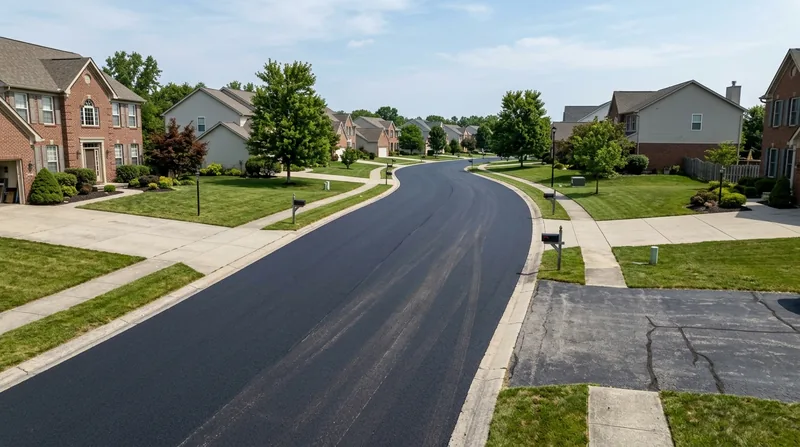




Private Road & HOA Paving in Cincinnati requires a different approach than a residential driveway. HOA roads in subdivisions across Butler and Warren counties carry sustained traffic from multiple households, delivery trucks, and service vehicles. The Cincinnati basin, the hillside suburbs, and the ridge-top developments all see freeze-thaw cycles that crack thin bases and saturated clay that shifts under load. A private road or HOA drive needs a base thick enough to handle that traffic, proper pitch to shed rain, and drainage that keeps water from pooling beneath the surface. We build private roads to move vehicles reliably for years, not just to look finished on opening day.
Why Private Road & HOA Paving Matters in Cincinnati Suburbs
Private roads in master-planned communities across Mason, West Chester, Blue Ash, and Sharonville wear faster than homeowner driveways because the traffic load is higher and more constant. A road serving 20 or 30 homes accumulates miles of wheel passes every week. Freeze-thaw damage, edge cracking, and base failure happen sooner on undersized pavements. Cincinnati's wet springs and freeze-thaw winters accelerate failure in roads built with inadequate base depth or poor drainage. HOAs often face budget constraints and competing priorities, which makes choosing the right repair or replacement strategy essential.
- HOA roads carry cumulative traffic that thins asphalt faster than a single-family driveway sees wear.
- Cincinnati's saturated spring soils and freeze-thaw cycles break down weak bases within five to eight years.
- A properly pitched and drained private road lasts 12 to 15 years before resurfacing becomes necessary.
- Early repair or resurfacing of small failures prevents the base from failing and requiring full replacement.
- Drainage design and base thickness are the two factors that determine how long a private road survives.
The difference between a road that fails in six years and one that lasts fifteen is the base and the drainage, not the asphalt surface alone.
Key info: HOA architectural standards and municipal permitting vary by community. The city of Cincinnati requires contractor registration for work within city limits, and suburbs like Montgomery, Madeira, and Forest Park set their own permitting rules. Always verify local requirements with your HOA board and your village building department before soliciting bids. See Cincinnati Planning & Zoning for city guidance.
How We Build Private Roads & HOA Paving in Cincinnati
We start with a site walk to measure the road, identify drainage issues, and check the existing base. Most private roads in Cincinnati subdivisions sit on glacial clay or compacted fill that sheds water poorly. We establish proper slope across the full width so rain runs to shoulders or catch basins, not pooling in the middle. We specify base thickness in writing, with tonnage and compaction, so you know what goes under the asphalt. The result is a road built for the traffic and climate it will see, not a thin overlay that fails in four years.
- We measure the road, verify existing drainage, and probe the base to confirm its condition.
- We remove failed asphalt and prepare the base with proper compaction and slope.
- We specify and deliver the correct tonnage of hot mix asphalt and compact it to manufacturer density.
- We pitch the road to shed water and establish shoulders or swales to direct runoff away from the pavement.
- We provide a written estimate with thickness, tonnage, and compaction specs so you know what you are paying for.
A private road is not a driveway scaled up. It is a load-bearing surface with engineering constraints that matter to the HOA and the homeowners who drive on it every day.
Example: A private road in West Chester serving 24 homes was paved eight years ago with a 2-inch overlay on a failing base. Alligator cracking covered 35 percent of the surface. We removed the old asphalt, placed 6 inches of compacted base, and paved with 2.5 inches of hot mix. The road is now in its second year and shows no cracking. The thicker base and proper compaction made the difference.
Private Road & HOA Paving Methods: Repair, Overlay, or Full Replacement
| Approach | Description | Best for |
|---|---|---|
| Pothole & crack repair | Full-depth patching of isolated failures, sealed with hot mix and compacted to match existing surface. | Early-stage failure on roads with a sound base; extends life 2-3 years. |
| Resurfacing & overlay | 2 to 3 inches of new asphalt over the existing surface after milling and base prep. | Roads with surface cracking but a solid base; adds 10-12 years of life. |
| Full-depth replacement | Remove all asphalt, prepare or replace base, place new 5-6 inch asphalt structure. | Roads with failed base, alligator cracking over 40 percent of surface, or severe settling. |
| Mill & overlay | Mill off 1.5-2 inches of old asphalt, grade the base, and place new hot mix. | Roads with moderate surface wear; recycles old material and lowers cost versus full removal. |
The right method depends on the base condition and how much of the surface has failed. We recommend repair or resurfacing whenever the base is sound. Full replacement is necessary when the base has shifted or when cracking covers more than 40 percent of the road. Learn more about resurfacing and overlay options to understand the choice between these methods.
Private Road & HOA Paving Cost in Cincinnati: What to Expect
Private road and HOA paving costs in Cincinnati start at $15,000 for a small private drive serving four or five homes and extend to $40,000 or more for a longer road serving 20+ homes. The cost per linear foot ranges from $40 to $60 depending on width, base condition, drainage work, and whether milling or full removal is required. A typical quarter-mile private road in a West Chester or Blue Ash subdivision costs between $20,000 and $35,000 for full-depth replacement with proper base and compaction. Overlay or resurfacing costs 30 to 40 percent less because it preserves the existing base.
Factors that move the price up or down include:
- Road length and width determine total square footage and material tonnage.
- Base condition decides whether you need repair, overlay, or full replacement.
- Drainage work, grading, and swale installation add cost but prevent future failure.
- Milling and recycling of old asphalt reduces disposal cost but adds milling hours.
- Slope and pitch requirements in hilly areas may require additional grading or base work.
Get written estimates from two or three contractors that include road length, width, square footage, base thickness in inches, tonnage of material, and compaction specs. A contractor who will not put these details in writing is not the contractor to hire. See our full pricing guide for more detail on what moves costs in different scenarios.
What to Look for When Hiring a Private Road Paving Contractor Near Cincinnati
Hiring the right contractor for an HOA road is different from hiring someone for a driveway. The road is a shared asset, and the work must be documented and warranted clearly. A reputable contractor will be fully insured, provide references from other HOA projects, and deliver a written estimate that includes all dimensions, tonnage, and compaction specs. Ask the contractor how they handle drainage, what base thickness they specify, and whether they will provide a compaction report. Verify that your HOA has approved the contractor and that any required municipal permits are in place before work starts.
- Request proof of current liability insurance and ask for the name of the insurer and policy limit.
- Ask for references from two or three HOA projects completed in the past three years.
- Verify that the contractor understands local permitting requirements for your village or suburb.
- Confirm that the HOA board has approved the contractor and the scope of work.
- Get a written estimate that includes road dimensions, base thickness, tonnage, and compaction method.
- Check that the contractor will handle any required utility locates through Ohio 811 before excavation.
A contractor who shows up with an unsolicited offer, no written contract, and a price that seems too good is not trustworthy. The standard for private road work is a site visit, a written estimate with full specs, a signed contract, and a timeline that allows for proper compaction and curing. Contact us for a free estimate and to discuss your HOA road project. We serve Cincinnati, Norwood, Cheviot, Sharonville, Blue Ash, Montgomery, Madeira, Forest Park, and surrounding communities.
Private Road & HOA Paving in Cincinnati: Pricing Guide
| Service | Price | Details |
|---|---|---|
| Pothole & crack repair on private road | Starting at $800 | Full-depth patching of isolated failures; cost increases with number of patches and road accessibility |
| Resurfacing & overlay (per 1,000 sq ft) | Starting at $3,500 | 2 to 3 inches new asphalt on sound base; price moves with base prep, milling, and drainage work required |
| Full-depth replacement private road | Starting at $15,000 | Complete removal, base prep, 5 to 6 inch new asphalt; typical quarter-mile road runs $20,000 to $35,000 |
| Mill & overlay (per 1,000 sq ft) | Starting at $2,800 | Milling, grading, new hot mix; lower cost than full removal; includes recycled material handling |
| Estimate & site visit | Free | Response within 24 hours at (513) 813-2379; includes dimensions, base assessment, and written quote |
Indicative pricing, the exact cost depends on square footage, finish, and site access. Free personalized estimate within 24h at (513) 813-2379.


