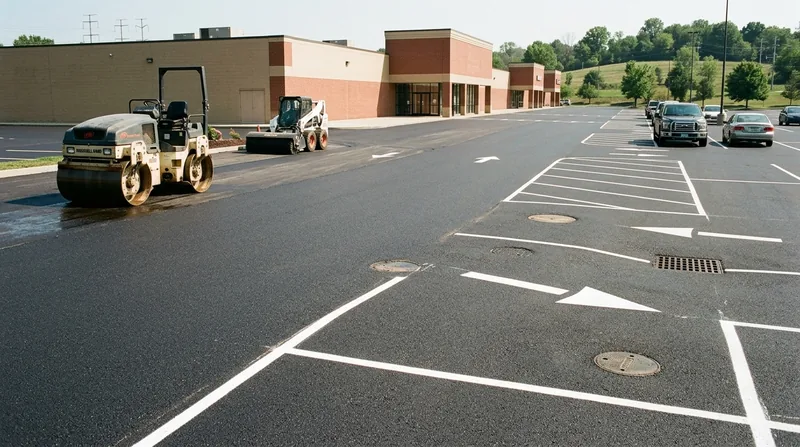




Commercial lots across Greater Cincinnati face a particular drainage and structural challenge: our wet winters, freeze-thaw cycles, and the region's varied terrain mean that parking lot paving and construction must be built to handle saturation and traffic stress that generic asphalt cannot absorb. Whether you operate a retail strip in Blue Ash, a medical office park in Montgomery, or a light industrial lot in Sharonville, the pavement under your customers' and employees' vehicles needs a solid base, proper grading for runoff, and hot mix that stands up to Cincinnati's spring thaw and winter loading. We build parking lots that shed water, support heavy traffic, and hold their surface for years, not months.
Why Parking Lot Paving and Construction Matters in Greater Cincinnati
Cincinnati's commercial real estate sits on glacial terrain that shifts seasonally. In the basin and on the hillsides, saturated ground in spring moves under pavement; on the ridges and in the suburbs like Mason and Fairfield, freeze-thaw cracking works through the asphalt itself if the base is not properly prepared and compacted. A parking lot that looks fine in July can fail by March if the base was not proof-rolled, if drainage was not graded into the surface, or if the asphalt was laid too thin to handle the stress. That failure shows up as edge cracking, potholes, and alligator cracking that spreads into the driving surface and costs far more to repair than it would have cost to build correctly the first time.
- We proof roll the compacted base to confirm it will support traffic without settling.
- We grade the lot for positive drainage so water runs off instead of pooling or soaking into the base.
- We specify asphalt thickness based on the traffic load your lot will carry, not a generic default.
- We lay hot mix in the right weather so the binder cures properly and the surface bonds to the base.
- We document tonnage and depth on your estimate so you know exactly what you are paying for.
A properly constructed parking lot in Cincinnati lasts 15 to 20 years with routine maintenance; a poorly built one fails in five to seven and costs thousands more to fix.
Key info: Cincinnati's building code and municipal permitting for parking lots are set by the city and vary by village and county. Impervious surface limits, stormwater rules, and curb cuts all require permits in most jurisdictions. Check with your local building department or the City of Cincinnati before you start. We help you navigate permitting, but the rules are yours to verify.
How We Build a Parking Lot in Cincinnati: The Right Way
A parking lot is not just asphalt poured over dirt. It is a layered system: base preparation, drainage grading, compaction, and then the asphalt itself. Each step builds on the last, and skipping any one of them is why lots fail early. Our process starts with the ground, not the surface.
- We excavate and grade the subgrade to remove soft soil and establish proper slope for water runoff.
- We place and compact the base course, typically recycled asphalt millings or crushed stone, in multiple lifts.
- We proof roll the base with heavy equipment to confirm it will not settle under traffic.
- We establish positive drainage with crown slope and edge details so water sheds off the pavement.
- We lay hot mix asphalt in lifts, starting with a binder course and finishing with a durable wearing surface.
- We compact the asphalt while it is hot to lock the aggregate and binder together.
The result is a lot that handles Cincinnati's traffic, weather, and seasonal ground movement. If you are planning an expansion or resurfacing an existing lot, see our page on parking lot repair and resurfacing for maintenance options.
Example: A 15,000-square-foot retail lot in Forest Park with poor drainage was failing in the spring every year. We removed the failed asphalt, regraded the subgrade for positive runoff, placed a 6-inch compacted base, and laid 3 inches of hot mix with a proper crown. The lot now sheds water, and five years later it is holding up to freeze-thaw traffic without edge cracking or potholes.
Methods and Approaches: Parking Lot Paving in Cincinnati
| Approach | Description | Best for |
|---|---|---|
| Full-Depth Replacement | Remove failed asphalt and base, excavate to stable subgrade, place new base and asphalt in full thickness. | Lots with failed bases, poor drainage, or where the subgrade has settled or shifted under seasonal stress. |
| Mill and Overlay | Remove the top 1 to 2 inches of asphalt, reset drainage slope if needed, and lay a new wearing surface. | Lots where the base is sound but the surface is cracked or rutted, and the overall thickness is adequate for traffic. |
| Recycled Base with New Surface | Mill the existing asphalt, recycle it as base course, compact, and lay new hot mix wearing surface. | Budget-conscious projects where the old pavement can be reused and the base is adequate for the traffic load. |
| Patch and Seal Repair | Remove isolated failed areas, patch with new asphalt, and address drainage around the repair. | Lots with localized potholes or edge failures where the rest of the pavement is structurally sound. |
Parking Lot Paving and Construction Cost in Cincinnati: What to Expect
The cost of a parking lot depends on size, existing condition, base preparation required, and whether you are starting from bare ground or overlaying existing pavement. A small retail lot might run $8,000 to $15,000 for a complete rebuild; a larger commercial property or light industrial lot can easily exceed $30,000. The best way to understand your specific cost is to call us for a free commercial estimate with written tonnage and thickness specifications.
Several factors move the price up or down. A lot with poor drainage or soft subgrade requires more excavation and base material. A lot with failed asphalt that must be removed and recycled costs less in base material than one that needs virgin crushed stone. A lot that is 5,000 square feet costs more per square foot than one that is 25,000 square feet because of mobilization and setup. Traffic load also matters: a lot that will carry delivery trucks and forklifts needs thicker asphalt and a stronger base than a lot used only for customer parking.
Getting two or three estimates from different contractors is smart. Compare what each estimate includes: base thickness, asphalt thickness, tonnage, drainage details, and timeline. An estimate that shows only a price and a square footage is not giving you enough information to judge quality or value. See our pricing overview for typical ranges and what drives cost in each category.
Parking Lot Paving and Construction Near Me: How to Choose the Right Contractor
Hiring the right paving contractor is as important as the work itself. A contractor who cuts corners on base preparation or drainage will deliver a lot that fails early. Here is what to look for when you are comparing contractors in Cincinnati, Norwood, Cheviot, or any of the surrounding communities.
- Ask whether the contractor is fully insured and ask to see a current certificate of insurance before work starts.
- Request written estimates with tonnage, thickness, and material specifications, not just a price per square foot.
- Ask for references from commercial lots built in the last three to five years, and call at least two of them.
- Verify that the contractor is local with a local address and local equipment, not a traveling crew with out-of-state plates.
- Check whether your city or village requires contractor registration or permits for parking lot work, and confirm the contractor understands local requirements.
- Ask about drainage and base preparation specifically. If the contractor does not talk about proof rolling, subgrade preparation, or grading for runoff, that is a red flag.
If you are ready to move forward, contact us for a free estimate at (513) 813-2379. We will visit your lot, measure it, assess the existing condition, and provide a detailed written estimate with tonnage and thickness specifications. No obligation, no pressure, and we respond within 24 hours.
Parking Lot Paving & Construction in Cincinnati: Pricing Guide
| Service | Price | Details |
|---|---|---|
| Free Commercial Estimate | Free | On-site visit, measurement, condition assessment, and written estimate with tonnage and thickness specs included |
| Mill and Overlay (sound base) | Starting at $4.50-$6.50/sq ft | Includes milling, drainage reset, compaction, and new wearing surface asphalt for existing lots with adequate base |
| Full-Depth Replacement | Starting at $7.00-$10.00/sq ft | Excavation, subgrade prep, base course, proof rolling, and new asphalt for lots with failed base or poor drainage |
| Recycled Base with New Surface | Starting at $5.50-$8.00/sq ft | Mill existing asphalt, recycle as base, compact, and lay new surface for budget-conscious rebuilds with adequate base thickness |
| Patch and Localized Repair | On estimate | Pricing depends on size and depth of failed area, base condition, and whether drainage work is required around the patch |
| Travel and Mobilization | Included | No separate mileage fee or call-out charge for Cincinnati and surrounding areas within service territory |
Indicative pricing, the exact cost depends on square footage, finish, and site access. Free personalized estimate within 24h at (513) 813-2379.


