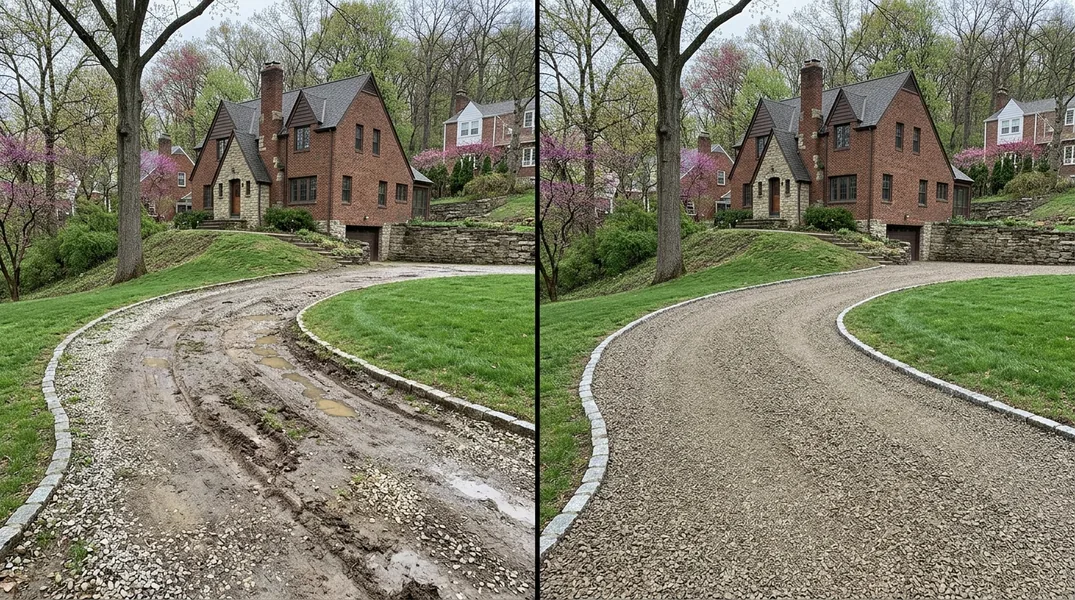
Understanding Frost Heave and Saturated Shale in Cincinnati
Every spring, homeowners across Cincinnati notice the same troubling pattern: their driveways suddenly develop new cracks, potholes appear where none existed before, and the entire surface seems to have shifted slightly. This annual phenomenon isn't random damage or poor installation. It's the direct result of how Cincinnati's unique geology interacts with seasonal freeze-thaw cycles, particularly on hillside properties where drainage challenges compound the problem.
The culprit is saturated shale soil, a common substrate throughout the greater Cincinnati region. Shale is a fine-grained sedimentary rock that becomes extremely problematic when water saturates it. Unlike sandy or well-draining soils, saturated shale holds moisture like a sponge and expands dramatically when that water freezes during winter months. This expansion, called frost heave, literally pushes your asphalt driveway upward and creates internal stress that leads to cracking, buckling, and eventual failure. On hillsides, gravity compounds the issue as the expanding soil pushes downslope, creating uneven surfaces and accelerating deterioration.
How Winter Freeze-Thaw Cycles Damage Hillside Driveways
The freeze-thaw cycle is relentless in Cincinnati winters. When temperatures drop below freezing, any water trapped in soil and within asphalt cracks expands by approximately 9 percent. This expansion creates enormous pressure that forces asphalt upward and sideways. Then, when temperatures rise above freezing, the ice melts and the soil settles back down, but not always evenly or completely. Hillside driveways experience this stress asymmetrically because gravity continuously pulls the soil downslope, preventing it from settling back to its original position. After multiple freeze-thaw cycles over a single winter, your driveway has shifted, settled unevenly, and developed internal fractures that weaken its structural integrity.
What makes this process particularly damaging is that it happens repeatedly throughout the season. A single winter in Cincinnati can include 30 to 40 freeze-thaw cycles, each one contributing to cumulative damage. By spring, when the ground finally stabilizes and temperatures remain consistently above freezing, homeowners discover that their driveways have developed significant problems. The cracks that appear aren't just surface issues; they're evidence that the foundation beneath the asphalt has moved. This is why Driveway Repair services become so critical in spring, and why many property owners find themselves needing more extensive work than they initially expected.
Why Hillside Properties Face Greater Risk
Hillside driveways in Cincinnati face compounded challenges that flat or gently sloping properties simply don't experience. Gravity constantly works against proper drainage on slopes, meaning water naturally accumulates at the base of hillside driveways and along their lower edges. This water infiltration is the primary cause of soil saturation. Additionally, hillside properties often experience faster water runoff during spring snowmelt and heavy rain events, which can overwhelm drainage systems and force water to pool beneath the asphalt surface. The combination of poor drainage and naturally saturated shale soil creates ideal conditions for frost heave damage.
The directional stress on hillside driveways is also more severe. As saturated soil freezes and expands, the expansion isn't uniform. Soil on the upper portion of the slope may expand differently than soil at the lower edge, creating differential heave. This uneven expansion is what causes the distinctive buckling, cracking, and settling patterns that homeowners observe. A driveway that appears to have multiple problem areas may actually be suffering from a single underlying cause: uneven frost heave on saturated shale. Understanding this helps explain why surface-level repairs often fail to solve the problem permanently.
Recognizing Spring Driveway Damage: Cracks, Potholes, and Buckling
Spring damage from frost heave typically manifests in three distinct ways. Cracks are the most common sign, and they often follow specific patterns. Linear cracks that run parallel to the slope indicate differential heave, while spiderweb or alligator cracking patterns suggest multiple areas of the driveway have shifted at different rates. Potholes develop where cracks have allowed water to penetrate deep into the asphalt base layer, weakening the structure until a section finally fails. Buckling or upheaval, where sections of the driveway are visibly raised higher than adjacent sections, is a clear indicator of significant frost heave damage beneath the surface.
If you notice any of these issues, it's important to assess whether you need Pothole Repair & Asphalt Patching or a more comprehensive solution like Asphalt Resurfacing & Overlay. Surface patches may temporarily hide the problem, but if the underlying soil continues to move, patches will fail again within months. This is why Cincinnati Asphalt Paving recommends a thorough evaluation of your driveway's condition before committing to repairs. The choice between patching and more extensive work depends on how much of your driveway is affected and how severe the underlying soil movement has been.
Repair or Replace: Making the Right Decision for Your Hillside Driveway
When spring damage appears, homeowners face a critical decision: should they pursue targeted repairs or invest in a complete solution? The answer depends on several factors, including the extent of damage, the age of your current driveway, and the underlying soil conditions. If damage is limited to a few localized areas and your driveway is relatively young, Pothole Repair & Asphalt Patching may be appropriate. However, if multiple areas are affected, if your driveway is already 15 or more years old, or if you've had to repair the same spots repeatedly, replacement or comprehensive resurfacing is often the more cost-effective long-term solution.
The key consideration for hillside properties is that addressing surface damage without solving the underlying drainage and soil saturation problem is essentially temporary. A new asphalt surface will eventually succumb to the same frost heave pressures that damaged the original driveway. This is why many Cincinnati homeowners ultimately choose Asphalt Driveway Paving & Installation with improved drainage solutions. Installing proper grading, drainage swales, or subsurface drainage systems alongside new pavement can significantly extend the life of your investment. While the upfront cost is higher, the durability and reduced maintenance make it worthwhile for most hillside properties in the Cincinnati area.
Protecting Your Driveway: Prevention and Professional Solutions
The best approach to managing frost heave damage is prevention. For existing driveways, seal coating every two to three years can slow water penetration and extend pavement life. Maintaining proper drainage around your driveway by cleaning gutters, directing downspouts away from the pavement, and ensuring grading slopes away from the surface will reduce soil saturation. For hillside properties, consider installing or improving drainage systems that prevent water from accumulating beneath the asphalt. These preventive measures won't eliminate frost heave entirely, but they can significantly reduce its severity and extend the time between major repairs.
When damage does occur, professional evaluation is essential. Cincinnati Asphalt Paving offers free estimates and can assess whether your driveway needs simple patching, comprehensive resurfacing, or complete replacement. Our team understands the specific challenges that saturated shale soil and hillside properties present in the Cincinnati region. We can recommend solutions tailored to your property's drainage characteristics and soil conditions. If you've noticed spring damage on your hillside driveway, contact Cincinnati Asphalt Paving at (513) 813-2379 to schedule your free estimate today. The sooner you address these issues, the more options you'll have and the less structural damage will occur.
Looking for a professional asphalt paving contractor in Cincinnati? Cincinnati Asphalt Paving responds fast for all your asphalt paving needs.
Get a Free Quote